
Digitalisation: energy needs a data trail
A solar module without data is a sheet of glass with an unknown history. I am working to make every module and every kilowatt hour traceable, from installation through its second life to sharing in an energy community.
What does digitalisation mean in the life cycle of a solar panel?
Digitalisation means that every module has a traceable data trail from installation to recycling: manufacturer, type, serial number, test results and condition. Only with this data can you decide safely whether a module is reused or recycled.
Today this knowledge is usually lost when the modules come down. A solar park is dismantled, the modules end up on pallets, and at their destination nobody knows where they came from, how old they are or what has happened to them. What remains is testing every single module, or the shredder.
- Manufacture
- manufacturer, type, serial number, datasheet
- Operation
- location, yield, maintenance, damage
- Removal
- date, reason, transport
- Testing
- power measurement, electroluminescence, insulation test
- Grading
- condition class and decision: reUSE or reCYCLE
- Recovery
- recovered materials and where they go
What is CYCLECTRA?
CYCLECTRA is the AI-supported platform we are building at GE4A to bring together, sort and digitalise data on used solar modules. Tokenising these data records is planned as the next stage and is not yet in operation.
The data on a used module is scattered: on the rating plate, in the manufacturer's datasheet, in test reports, in shipping documents. CYCLECTRA is meant to connect these sources and give every module a digital record that is created during testing in the reCOGNISE step and accompanies the module through reUSE or reCYCLE. How such records could later become tradable digital assets is something I describe on the tokenisation page.
What is the EU digital product passport?
The digital product passport is an electronic data record for a product, introduced by the Ecodesign for Sustainable Products Regulation (EU) 2024/1781. The regulation entered into force on 18 July 2024; the Commission decides step by step, in separate legal acts, which products will need a passport.
The Commission adopted its first working plan on 16 April 2025. Its priority product groups include iron and steel, aluminium, textiles, tyres, furniture and mattresses, plus horizontal requirements on reparability and on the recycling of electrical and electronic equipment. Solar modules are not on this priority list. They were included in the older Ecodesign Working Plan 2022 to 2024, which still falls under the previous Ecodesign Directive.
I am not waiting for it. For used modules we need the data trail today, because every decision about reuse depends on it. When the product passport for solar modules arrives, the industry should be able to fill it with data that already exists.
When does the EU battery passport start?
Under the EU Batteries Regulation (EU) 2023/1542, batteries for light means of transport, industrial batteries with a capacity above 2 kWh and electric vehicle batteries will need a digital battery passport from 18 February 2027.
Under the regulation, stationary battery storage counts as an industrial battery, even when it sits in a private home. So the battery passport affects many home batteries installed alongside a solar system. For batteries, the data trail becomes mandatory earlier than for solar modules.
What is energy sharing?
Energy sharing means that households, small and medium-sized enterprises and public bodies share renewable electricity they generate themselves with others over the public grid. The EU wrote this right into the Electricity Directive as Article 15a through Directive (EU) 2024/1711.
Sharing is allowed within the same bidding zone or within a smaller area that each member state defines. The shared electricity is deducted from the participants' metered consumption for billing. The transposition deadline ended on 17 July 2026. At the end of September 2026 the European Commission sent formal notices to 18 member states, including the Netherlands, for failing to transpose it.
Germany transposed the requirement in Section 42c of its Energy Industry Act (Energiewirtschaftsgesetz, EnWG). Since 1 June 2026, consumers can share electricity within the balancing area of a distribution system operator, and from 1 June 2028 also with the directly adjacent grid area. Participants can be private individuals, micro, small and medium-sized enterprises, and municipalities and other public bodies.
At its core, energy sharing is a data task. Someone has to measure who generates and consumes how much and when, and the allocation has to be billable. Without digitalisation, the right stays on paper.
What role does PVSmile play?
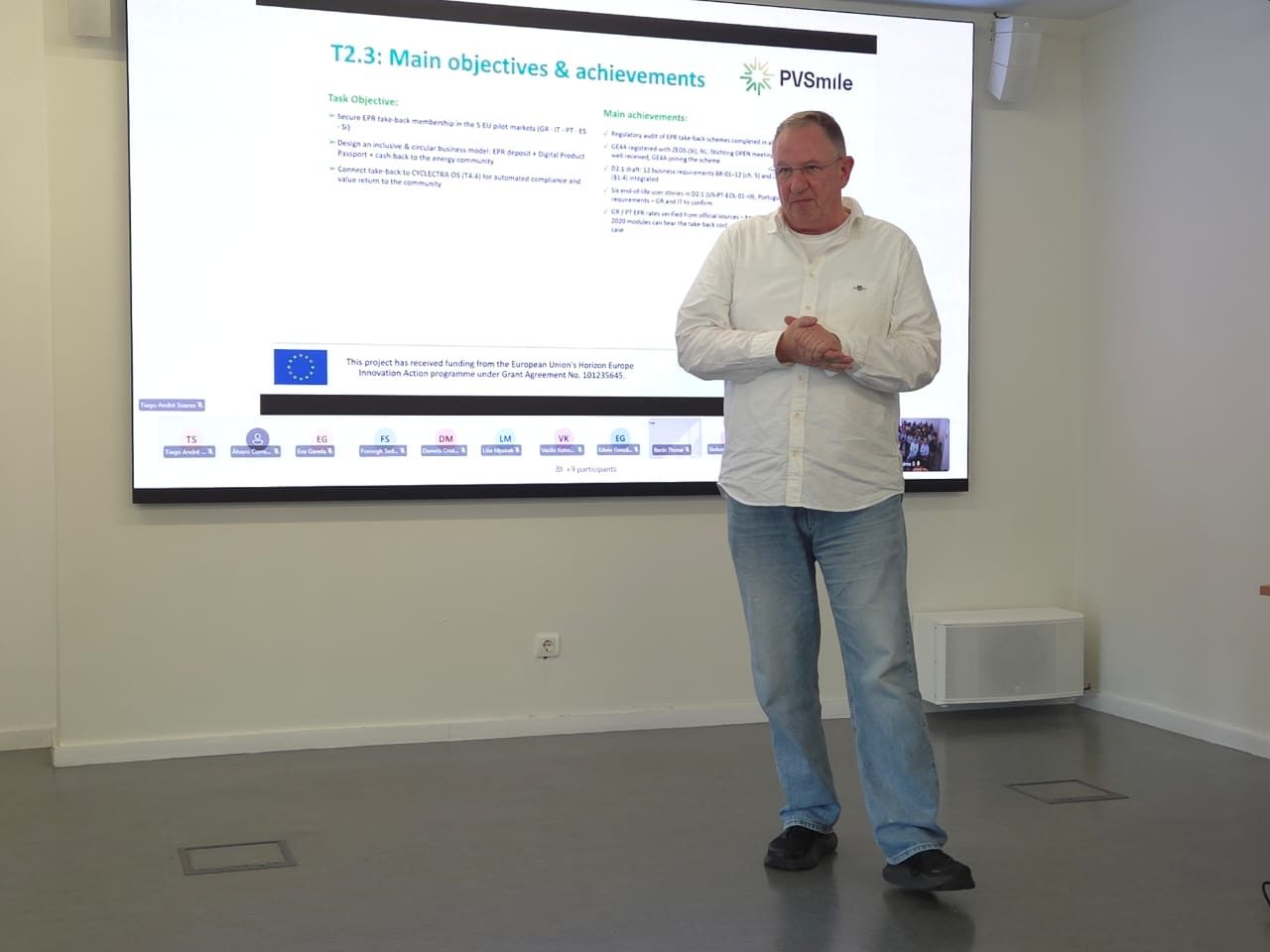
PVSmile is a Horizon Europe project that digitalises the photovoltaic life cycle for energy communities from 1 November 2025 to 31 October 2028. Toralf Nitsch's company GE4A Group B.V. is one of 28 partners from ten countries, coordinated by the National Technical University of Athens (NTUA).
At GE4A we are working in PVSmile on a blueprint that makes energy sharing possible everywhere in the EU, however far a country has got with transposing the rules. The project runs under grant agreement 101235645. More about my EU projects
What does vehicle-to-grid have to do with energy communities?
Vehicle-to-grid means that an electric car returns stored electricity to the home or the grid when needed. This turns the car battery into storage that an energy community can share.
In 2009 I worked in China on one of the country's first fully electric cars. Even then it was clear that the car, the battery and the solar roof belong together. For a car to give power back, you need bidirectional charging, metering and clear billing. That, too, is first and foremost a question of data.
Energy change is about creating a decentralized, digital, and bidirectional energy world.
Why is digitalisation the precondition for a circular economy and tokenisation?
Because you can only keep in circulation, share and trade what you can measure and prove. Data is the foundation for a module's second life, for an energy community and, later, for a digital asset.
That is why my path leads from balcony solar through refurbishing used modules to the data trail, and from there to tokenisation. Each step depends on the one before.
Frequently asked questions about digital energy
Do solar panels need a digital product passport?
Solar modules do not need an EU digital product passport yet. The Ecodesign for Sustainable Products Regulation (EU) 2024/1781 creates the framework for digital product passports but leaves the individual product groups to later legal acts. Solar modules are not among the priorities in the first working plan of April 2025.
When does the EU battery passport start?
The EU battery passport applies from 18 February 2027 to batteries for light means of transport, electric vehicle batteries and industrial batteries above 2 kWh. This includes stationary home batteries of that size.
Can I share solar power with my neighbours in Germany?
Yes, since 1 June 2026 you can share solar power with neighbours in Germany under Section 42c of the Energy Industry Act (EnWG), provided the installation and the consumers are in the balancing area of the same distribution system operator. From June 2028 the directly adjacent grid area is added.
What is an energy community?
An energy community is a group of citizens, businesses or municipalities that jointly generate, store or share renewable electricity. Energy sharing under EU Directive 2024/1711 gives such groups the right to use the public grid to do so.
What is CYCLECTRA?
CYCLECTRA is an AI-supported platform from GE4A Group B.V. that brings together, sorts and digitalises data on used solar modules. It is currently being expanded; tokenisation is planned as the next stage.
What does GE4A do in the EU project PVSmile?
In PVSmile, GE4A is working on a blueprint to make energy sharing possible in all EU member states. The project digitalises the PV life cycle for energy communities and runs until October 2028.